The Road Ahead: Populism and Japan’s ODA Strategy in ASEAN

The Road Ahead: Populism and Japan’s ODA Strategy in ASEAN

Vol. VII / No. 9 | May 2026

Authors:

Ahmad Fauzan Abbas – International Relations Graduate from Hasanuddin University


Summary

Populism in Japan is rooted in unresolved socioeconomic problems and dissatisfaction with the government. We then expand our discussion to assess the possible implications of populist aspirations towards Japan’s Official Development Assistance (ODA) programme in ASEAN. We found that the surge of populist campaigns in Japan has not gathered sufficient power to influence the flow of Japan’s ODA. This essay serves as a preliminary research on the growing literature that seeks to explain the rise of populism in Japan and its implications for Japan’s foreign policies.

Keywords: Populism, Official Development Assistance, Japan-ASEAN Relations

Populism In Japan

Japan’s Liberal Democratic Party’s (LDP) poor performance in the 2024 and 2025 elections has brought two implications. First, as the ruling party, the LDP’s consecutive losses in the 2024 and 2025 elections have weakened the party’s stance in the parliament (Govella, 2025). Grappling with this dilemma, Shigeru Ishiba, LDP’s sitting president and the prime minister of Japan, was forced to resign. After a tight LDP presidential election in the runoff, Sanae Takaichi soon assumed the party’s executive and the prime minister’s office. Second, the election campaign showed a rising concern regarding populist aspirations, which strongly correlates with the election result. The emergence of populist trends in Japan’s politics may be rooted in public dissatisfaction with socioeconomic problems. Key issues include the weakened Japanese economy and loose immigration policies  (Kimijima, 2025 ; Higuchi & Koo, 2025).

History has shown examples where populist regimes redirect their country’s foreign policy towards more hostile relations with others. Donald Trump is a notable example, with political scientists referring to him as a populist par excellence (Oliver & Rahn, 2016). Trump also shares the same narrative that immigrants enjoy the social benefits while the “true” citizens must endure economic hardship. His populism also pushes for re-orientation towards domestic issues. ASEAN countries then started to contemplate the impact of the populist wave in Japan that might influence how the Japanese view Official Development Assistance (ODA) in the region.


How Populism Influenced Foreign Aid?

There is still substantial debate among academics regarding the solid definition of populism (Mudde & Kaltwasser, 2017 ; Laclau, 2005). However, one shared element among them is the narrative of the “people majority” vs “elite minority”. This element is also highlighted in one of the most widely used approaches in the study of populism, the “ideational approach”. In this perspective, populism is seen as a thin-centered ideology. The society then separated into two clusters: “the pure people” against “the corrupt elite”. This approach believes that politics should express the general will of the people (Mudde, 2004).

Political scientists keep working to expand the study of populism, including on how populist movements may impact a country’s foreign policies. Destradi’s elaborate work (2025) on populism and foreign policy theorisation examined the correlation between the two through Mudde’s ideational approach. According to Destradi, as the consequences of populism as a “thin-centered” ideology, the effects do not directly translate as the substance of a country’s foreign policies. Rather, populist regimes influence foreign policies in procedural practices, that is, through personalization and mobilization.

Investigating the correlation between populist sentiment and foreign aid remains a relatively niche theme in the study of IR. Heinrich et al. (2021), offer a systemic examination of the relationship between the two. They conclude that anti-elitism and nativism (a major theme of populist campaigns) correlate with the reduction in government spending on foreign aid. The argument is that, in democratic competition, the incumbent government seeks electoral support from the masses. The electoral motives then allow the public to dictate government foreign aid spending.


Sanseito’s Populism and The Prospect of Japan’s ODA

The presence of populist campaigns could direct Japan’s foreign policies into an inward-looking stance. Questions have arisen about whether this may adversely affect foreign aid to recipient countries, notably, the members of ASEAN. A review of the figures (Table 1) indicates that a huge proportion of Japan’s ODA is distributed among Southeast Asian countries.


Japan’s ODA to ASEAN (in million yen)
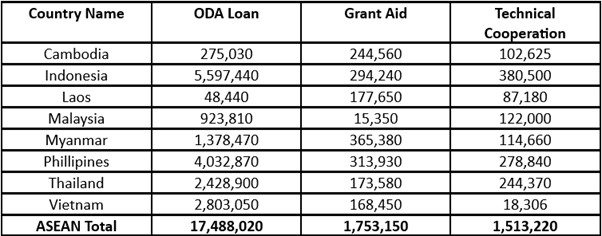
Source: ODA Data Book by Country 2023, MOFA,  in
the
Ministry of Foreign Affairs of Japan (MOFA), 2025.


These concerns are not without basis. Shortly after being re-elected, President Trump instructed the suspension of U.S. foreign aid to other countries. The White House (2025) argued that the halt was intended to reassess the programme, which is distributed through various schemes of humanitarian issues. The policy itself is in line with Trump’s America First campaign. A populist proposal proved successful in securing his victory in the 2024 presidential election.

Sanseito, a rising populist opposition party in Japan, has consistently aligned with populist rhetoric that mobilizes the masses who are insecure about the current socioeconomic reality of today’s Japan (Takao, 2025). This faction later antagonizes the elite, whom they believe are responsible for the problems faced by Japanese society. In this context, Sanseito’s Japanese First slogan is a direct rendering of Trump’s America First. Both campaigns share the same characteristics. They embrace the ultra-conservative and nationalist ideologies while blaming the immigrants, liberal elites, and foreign capital (McCurry, 2025). The question that arises is whether Sanseito would also target Japan’s ODA scheme?

The short answer is no. As of today, Sanseito has never directly expressed any objection towards Japan’s ODA programme. Nevertheless, they repeatedly express their pessimistic stance towards globalism, which they view as a large corporation and the ideology of capital owners. From their view, globalism only produces economic injustice, undermines democracy, weakens the middle class, and erodes national sovereignty and identity (Sugawara, 2025).

If Sanseito decides to oppose the ODA programme, they would not be able to push for any substantial change of said policy, given the small size of their coalition inside the government. Here lies the major difference between Trump’s America First and Sanseito’s Japanese First: one represents a ruling regime, while the other is a minority opposition. Nevertheless, Sanseito’s popularity has increased in the last three elections. The party managed to increase the size of its seat in the House of Representatives to fifteen in the latest general election (Sonobe et. al., 2026). If this tendency continues, then Sanseito can be a game changer in Japanese foreign policy-making.


Putting Takaichi in the Equation

Our focus now turns to Sanae Takaichi. As the Prime Minister of Japan, her stance on Japanese ODA is significant. On various occasions, Takaichi has campaigned in line with Sanseito’s sentiments (see Simpson, 2025). Despite her use of populist rhetoric, Takaichi cannot be simply labelled as a populist actor. We need to differentiate between a populist and an opportunist who use general populist themes (such as conservatism and nationalism) to secure their vote.

As Prime Minister Shinzo Abe’s protégé, Takaichi is likely to continue the legacy of her mentor, the existing Free and Open Indo-Pacific strategy (Anindya, 2025). Takaichi will not deliberately sever ties with ASEAN, given its centrality to Japan’s economy and regional stability. Developing countries that act as an economic engine for ASEAN, such as Indonesia, Vietnam, and the Philippines, are expected to continue receiving assistance for domestic infrastructure and institutional initiatives.

Through the ODA programme, Japan has actively contributed to the development of ASEAN member states. In Jakarta and Manila, Japan has supported public transportation projects. In disaster risk management, the Japan-ASEAN Integration Fund has supported ASEAN’s humanitarian assistance and disaster management efforts. In terms of health cooperation, Japan has assisted ASEAN in strengthening the association’s capacity to respond to public health emergencies (MOFA, 2025).

In our analysis, Takaichi would respond to the citizens of Japan’s opinion on the issue of international cooperation funding. A poll from the Ministry of Foreign Affairs (2026) showed that 50,3% of Japanese respondents believe that the ODA scheme plays a role in securing resources and food. Some respondents also agree that ODA helped to promote peace, stability, and increase the prosperity of Japan while also increasing Japan’s exports. This highlights the positive sentiment of Japan’s citizens towards the ODA strategy.

To conclude, the generally positive sentiment among citizens validates the government’s policy on ODA spending. The populist actor Sanseito has also not targeted international assistance policy on a large scale, in contrast to the Trump administration in the United States. Populist in Japan have instead focused primarily on domestic socioeconomic issues, such as immigration and the economy. This helps explain the near absence of campaigns against ODA in Japan, which in turn supports the continuation of the program.


Securitizing Migration: Political Polarization and the Institutionalization of ICE Enforcement in the United States

Securitizing Migration: Political Polarization and the Institutionalization of ICE Enforcement in the United States

Vol. VII / No. 8 | May 2026

Authors:

Clarissa Aldora Simamora – Undergraduate Student, Department of International Relations, Brawijaya University


Summary

Following the 2024 U.S. presidential election, Immigration and Customs Enforcement (ICE) arrests increased sharply, with enforcement intensity varying widely across states. This article argues that these disparities reflect the securitization of migration within a polarized political environment. Immigration governance has shifted from routine regulation toward institutionalized security enforcement embedded in detention systems and local policing. Drawing on enforcement data and empirical research on social impacts, the article shows how political polarization and public performance politics normalize extraordinary measures. While intensified enforcement is justified in the name of sovereignty and public safety, its consequences extend beyond arrest figures, affecting immigrant communities and student achievement. The article ultimately highlights a tension between state-centered security and human security, questioning whether current enforcement strategies reinforce long-term stability or generate deeper structural insecurity.

Keywords: Migration, Securitization, ICE, Politics of Fear, Human Security

Political Polarization and Uneven Enforcement

It is not only partisan divides that shape immigration enforcement on the ground. Enforcement patterns are also influenced by institutional capacity, prosecutorial discretion, and the willingness of local law enforcement agencies to cooperate with federal authorities. Democratic-led states such as California generally support sanctuary policies and limit cooperation with federal immigration agencies, thereby reducing the operational reach of ICE within local jurisdictions. By contrast, Republican-led states such as Texas often mandate collaboration with federal authorities, prohibit sanctuary protections, and strengthen federal–local enforcement partnerships. These differing political orientations shape whether immigration enforcement becomes more constrained or normalized within state governance. As a result, federal immigration enforcement is implemented unevenly across states and is significantly influenced by domestic political dynamics and partisan alignments.

Such fragmentation has broader implications. It generates inconsistent exposure to enforcement risks, meaning that the lived experience of immigration policy differs dramatically depending on state of residence. This territorial unevenness reinforces the perception that migration governance is not merely legal administration but an arena of political contestation. Enforcement intensity becomes a symbolic extension of partisan identity, deepening polarization rather than producing uniform regulatory outcomes.

ICE arrest data show a sharp increase following the 2024 election, as documented by the UCLA Center for Neighborhood Knowledge (2025).  However, enforcement intensity differs dramatically across states. In some states, arrest rates remain below one per 1,000 non-citizens, while in others they exceed twenty per 1,000—an extraordinary disparity detailed in State Variations in ICE Arrests (2025). These differences are too large to be explained simply by demographic distribution or uniform federal statutes.

A closer comparison between California and Texas illustrates this divergence. Despite California having a comparable or larger non-citizen population, Texas recorded significantly higher arrest rates after adjusting for exposure risk, as shown in the California limits cooperation with federal immigration authorities, while Texas mandates collaboration and prohibits sanctuary-style protections, as also discussed in the ICE Arrests in California and Texas (2025). These differences demonstrate how immigration enforcement is shaped not only by federal law, but also by state-level political priorities and local institutional cooperation.

These patterns demonstrate that immigration enforcement is not merely the mechanical execution of federal law. Instead, it is filtered through local political will, institutional cooperation, and partisan alignment. Immigration policy becomes territorially differentiated, reflecting ideological divides rather than uniform administrative practice. In this sense, enforcement intensity operates as an extension of political identity.

Framing Migration as a Security Threat

Securitization theory provides a framework for understanding how migration shifts from policy issue to perceived existential threat. As explained in Security Studies: An Introduction (4th ed.), securitization occurs when political actors frame an issue as requiring extraordinary measures beyond normal democratic procedures.

The conceptual foundations of this approach are elaborated in Regions and Powers: The Structure of International Security (2003), which argues that security is socially constructed rather than objectively determined. Migration does not inherently threaten state survival. It becomes threatening when framed as endangering sovereignty, identity, or social cohesion.

Debates within contemporary security scholarship, summarized in Modern Schools of Thought in Security Studies (2023), further show how migration is often placed within the societal security sector. Here, concerns about cultural change and national identity become central to political discourse.

In the U.S. context, decades of rhetoric linking immigration to crime, border disorder, and demographic anxiety have contributed to this framing. Once migration is accepted as a security issue, expanded enforcement powers become politically defensible. Emergency language justifies extraordinary measures.

This idea is supported by what securitization scholars call “audience acceptance,” in which security narratives become influential once they are accepted and reproduced by the public. In contemporary securitization theory, threat narratives gain power not only because political elites promote them, but also because they resonate with segments of society that perceive demographic shifts, economic competition, or cultural change as destabilizing forces. This dynamic is further discussed in The US Deportation System: History, Impacts, and New Empirical Research (2025). Threat narratives gain power not simply because political elites articulate them, but because they resonate with segments of the public who perceive demographic change, economic competition, or cultural transformation as destabilizing forces. This dynamic is reflected in recent public opinion research on immigration enforcement in sensitive locations. A national survey conducted by In polarized political environments, such narratives become self-reinforcing. Media ecosystems amplify selective incidents, transforming isolated events into generalized patterns of perceived insecurity.

Over time, repeated exposure to such framing can normalize the assumption that migration inherently carries risk. The boundary between exceptional emergency and routine governance begins to blur. Once migration is widely understood as a security matter, resistance to enforcement expansion becomes politically costly, further entrenching securitized logic within institutional practice.

From Expansion to Institutionalization

Securitization becomes entrenched when embedded in bureaucratic structures. Evidence from The Landscape of Immigration Detention in the United States (2018) shows that detention capacity expanded dramatically over the past three decades, creating a dense nationwide enforcement infrastructure.

The growth of interior enforcement programs is examined in The Impact of Interior Immigration Enforcement on the Lives of Undocumented Immigrants (2024), which highlights how federal–local cooperation integrated immigration control into routine policing practices. Programs such as 287(g) blurred distinctions between civil immigration law and criminal enforcement.

The longer legislative trajectory of enforcement escalation is traced in From IIRIRA to Trump: Connecting the Dots to the Current U.S. Immigration Policy Crisis (2018), which documents how policy reforms steadily broadened deportation authority and normalized detention expansion.

What emerges is not a temporary reaction to crisis but a durable enforcement architecture. Securitization is no longer rhetorical; it is institutionalized through budgets, detention contracts, and interagency cooperation.

Politics of Fear and Executive Performance

Immigration enforcement also operates as political theater. Executive Spectacle Policing: Protest, Immigration, and Lessons from the Performance of State Power in the Trump Era (2025) describes enforcement actions as public displays of executive strength designed to convey authority and decisiveness.

Media amplification plays a crucial role in this process. Highly publicized raids and deportations circulate images of state control. Enforcement becomes visible reassurance to supporters that perceived threats are being managed.

Yet empirical research complicates the narrative linking immigrants to crime. Debunking the Myth of Immigrants and Crime (2020) finds limited evidence supporting claims that immigrants increase criminal activity. The persistence of threat framing therefore relies more on political communication than on statistical reality.

Language contributes symbolically. Beliefs and Opinions about “Illegal” and “Undocumented” Immigrants (2025) shows that terminology alone does not significantly change public attitudes, but reflects partisan alignment. Words signal identity more than they transform perception.

Together, these dynamics reveal how fear operates as a political resource. Enforcement is justified not only through law but through spectacle and narrative reinforcement.

Human Security and Intergenerational Consequences

Research on local immigration enforcement has also identified measurable educational consequences. ICE at the Door, Tests on the Floor: Student Achievement and Local Immigration Enforcement (2025) found that large-scale ICE arrest operations were associated with declining standardized test scores among Hispanic students, particularly in communities directly exposed to immigration enforcement activities. The study suggests that fear, stress, and disruptions within immigrant households can negatively affect students’ academic performance.

The consequences of immigration enforcement affect not only undocumented youth but also U.S. citizen children living in immigrant households. The same study suggests that increased absenteeism, stress, and fear within these communities can negatively affect students’ educational performance and contribute to broader intergenerational consequences. As a result, immigration enforcement produces indirect but tangible disruptions that may hinder long-term educational outcomes.

Broader psychological consequences are documented in The Impact of Immigration and Customs Enforcement on Immigrant Health (2011), which reports heightened anxiety, social withdrawal, and distrust toward public institutions. Fear extends beyond legal status and reshapes everyday life.

From a human security perspective, these findings raise normative concerns. As argued in The New Security Studies and Soft Power (2011), security should not be confined to state survival but encompass emancipation and individual well-being. When enforcement policies generate structural educational and psychological harm, the meaning of security becomes contested.

Conclusion: Competing Logics of Security

The surge in ICE arrests following the 2024 election reflects more than policy recalibration. It reveals how migration has been securitized, embedded in institutional practices, and normalized through political performance.

Territorial disparities demonstrate that enforcement intensity reflects partisan governance. Detention expansion shows bureaucratic entrenchment. Public spectacle reinforces narratives of threat. Empirical research reveals measurable social costs.

Migration governance thus becomes a site of competing security logics. One prioritizes sovereignty, control, and deterrence. The other emphasizes dignity, stability, and long-term social cohesion. The central question is not whether security matters, but whose security is prioritized—and whether the pursuit of state-centered security ultimately undermines the human foundations upon which it depends.

References

Ong, P., Ong, J., & Pech, C. (2025, July 30). State variations in ICE arrests. UCLA Center for Neighborhood Knowledge. https://knowledge.luskin.ucla.edu/2025/07/30/state-variations-in-ice-arrests-following-the-2024-election/

Ong, P., & Ong, J. (2025, September). ICE arrests in California and Texas: Polarized politics and outcomes. UCLA Center for Neighborhood Knowledge. https://knowledge.luskin.ucla.edu/wp-content/uploads/2025/09/UCLA_CNK_ICE_Arrests_CA_TX_Sept2025.pdf

Nyman, J. (2023). Securitization. In P. D. Williams & M. McDonald (Eds.), Security studies: An introduction (4th ed., pp. 219–242). Routledge. https://doi.org/10.4324/9781003247821-9

Ryo, E., & Peacock, I. (2018). The landscape of immigration detention in the United States. American Immigration Council. https://www.americanimmigrationcouncil.org/wp-content/uploads/2025/01/the_landscape_of_immigration_detention_in_the_united_states.pdf

Hacker, K., Chu, J., Leung, C., Marra, R., Pirie, A., Brahimi, M., English, M., Beckmann, J., Acevedo-Garcia, D., & Marlin, R. P. (2011). The impact of Immigration and Customs Enforcement on immigrant health: Perceptions of immigrants in Everett, Massachusetts, USA. Social Science & Medicine, 73(4), 586–594. https://doi.org/10.1016/j.socscimed.2011.06.007

Buzan, B., & Wæver, O. (2004). Regions and powers: The structure of international security. Cambridge University Press.

Wong, T. K., & Shklyan, N. (2024). The impact of interior immigration enforcement on the lives of undocumented immigrants. The Journal of Race, Ethnicity, and Politics, 6(3), 669–687. https://doi.org/10.1017/rep.2024.19

Zhirkov, K., & Brehm, R. H. (2025). Beliefs and opinions about “illegal” and “undocumented” immigrants: Conceptual replication of a null result. Research and Politics, July-September 2025, 1–5. https://doi.org/10.1177/20531680251355233

Sorg, E. T. (2025). Executive spectacle policing: Protest, immigration, and lessons from the performance of state power in the Trump era. Policing and Society. https://doi.org/10.1080/10439463.2025.2535670

Al-Rasheed, M. A. A., & Al-Saeedi, U. M. B. (2023). Modern Schools of Thought in Security Studies. Migration Letters, 20(S5), 646–660.

Bennett, C., Graves, V., & Meadows, B. (2025). ICE at the Door, Tests on the Floor: Student Achievement and Local Immigration Enforcement. RSF: The Russell Sage Foundation Journal of the Social Sciences, 11(4), 104–122. https://doi.org/10.7758/RSF.2025.11.4.05

Kerwin, D. (2018). From IIRIRA to Trump: Connecting the Dots to the Current US Immigration Policy Crisis. Journal on Migration and Human Security, 6(3), 192-204. https://doi.org/10.1177/2331502418786718

Reshad, A. (2011). The new Security Studies and Soft power. Journal of American Science, 7(12), 1031-1036.

American Immigration Council. (2024). Debunking the myth of immigrants and crime (Fact Sheet). https://www.americanimmigrationcouncil.org/wp-content/uploads/2025/01/debunking_the_myth_of_immigrants_and_crime.pdf

Blackburn, C. C., & Callaghan, T. (2025). U.S. public opinion about immigration enforcement in sensitive locations. Journal of Immigrant and Minority Health, 28(1), 9–22. https://doi.org/10.1007/s10903-025-01772-0

Patler, C., & Jones, B. (2025). The US deportation system: History, impacts, and new empirical research. RSF: The Russell Sage Foundation Journal of the Social Sciences, 11(4), 1–24. https://doi.org/10.7758/RSF.2025.11.4.01

Global South dalam Pencarian Arti dan Peran: Menuju Solidaritas Yang Bermakna

Global South dalam Pencarian Arti dan Peran: Menuju Solidaritas Yang Bermakna

Depok, 5 Mei 2026, Departemen Ilmu Hubungan Internasional, Fakultas Ilmu Sosial dan Ilmu Politik, Universitas Indonesia (FISIP UI) sukses menyelenggarakan seminar internasional bertajuk “Leadership Quest of the Global South: Representation, Development, and the Changing World Order” pada Selasa, 5 Mei 2026 di Auditorium Komunikasi FISIP UI. Seminar ini menghadirkan akademisi terkemuka dari berbagai negara untuk membahas dinamika kepemimpinan Global South di tengah perubahan tatanan dunia yang semakin kompleks dan multipolar. Kegiatan ini dimoderatori oleh Agung Nurwijoyo dan menghadirkan empat pembicara utama, yaitu Prof. Tang Xiaoyang (Tsinghua University, Tiongkok), Dr. Susan Engel (University of Wollongong, Australia), Dr. Manoj Kumar Panigrahi (O.P. Jindal Global University, India), serta Dr. Makmur Keliat (Universitas Indonesia). Seminar ini juga menjadi momentum refleksi lebih dari 70 tahun Konferensi Asia-Afrika Bandung 1955, yang menjadi tonggak solidaritas negara-negara Global South dalam melawan kolonialisme dan imperialisme.

Kerjasama yang setara: Global South sebagai Antitesis Hegemoni Barat

Dalam paparannya, Prof. Tang Xiaoyang menekankan bahwa konteks Global South telah mengalami transformasi signifikan sejak era Bandung. Jika dahulu kepemimpinan Global South berakar pada semangat anti-kolonialisme, saat ini dinamika tersebut semakin didorong oleh perkembangan ekonomi dan kemunculan kekuatan baru seperti Tiongkok, Brasil, dan Rusia. Ia menyoroti bahwa negara-negara Global South kini berupaya membangun tatanan dunia baru yang lebih setara, tanpa mengarah pada konflik terbuka, melainkan melalui kerja sama yang setara di tengah kompetisi global. Dalam konteks ini, Global South dinilai memiliki potensi untuk mempertahankan globalisasi di saat negara-negara Barat cenderung mengalami gejala deglobalisasi.

Kesenjangan dan Kompleksitas Domestik sebagai Bumerang 

Sementara itu, Dr. Susan Engel mengangkat pendekatan neo-Gramscian dalam melihat kepemimpinan Global South. Ia menekankan bahwa kepemimpinan tidak semata-mata dibangun melalui kekuatan material, tetapi juga melalui konstruksi ideologi dan konsensus sosial. Menurutnya, penting untuk mempertanyakan apakah proyek sosial yang dibangun oleh Global South bersifat emansipatoris atau justru reproduktif terhadap ketimpangan. Ia juga menyoroti perkembangan kerja sama Selatan-Selatan serta institusi seperti BRICS dan New Development Bank sebagai upaya alternatif terhadap sistem keuangan global, meskipun masih menghadapi tantangan terkait orientasi utang dibanding pembangunan.

Dari perspektif India, Dr. Manoj Kumar Panigrahi menyoroti bagaimana negara-negara Global South harus menghadapi rivalitas kekuatan besar sekaligus mengelola tantangan domestik seperti kemiskinan dan korupsi. Ia menjelaskan bahwa negara-negara seperti India mengadopsi strategi hedging dan keseimbangan dalam merespons dinamika global, sambil tetap menjaga kedaulatan politik dan memperluas kerja sama internasional. Ia juga menyoroti inisiatif seperti International Solar Alliance sebagai bentuk kontribusi Global South dalam isu global seperti perubahan iklim.

Melengkapi diskusi, Dr. Makmur Keliat menekankan pentingnya mendefinisikan ulang konsep Global South, apakah sebagai entitas politik atau ekonomi. Ia mengidentifikasi sejumlah tantangan utama, termasuk perbedaan kepentingan antarnegara, rivalitas antara kekuatan seperti India dan Tiongkok, serta hambatan struktural di tingkat domestik. Ia juga menekankan perlunya transformasi gagasan Global South menjadi langkah-langkah konkret, seperti penguatan konektivitas, pengembangan ekonomi maritim, hilirisasi industri, kedaulatan digital, serta mekanisme pembiayaan alternatif.

Visi ke Depan Global South: Lebih dari Sekadar Semangat Normatif

Sesi diskusi interaktif bersama peserta menyoroti berbagai isu krusial, seperti bagaimana menerjemahkan semangat Bandung ke dalam kebijakan konkret, peran Global South dalam mengatasi ketimpangan di kawasan ASEAN, serta tantangan pembangunan berkelanjutan. Para pembicara sepakat bahwa solidaritas tetap menjadi elemen penting, namun implementasi kebijakan tetap bergantung pada kapasitas dan komitmen masing-masing negara. Selain itu, muncul pula penekanan bahwa aktor non-negara, termasuk masyarakat sipil, memiliki peran strategis dalam mendorong agenda Global South yang lebih inklusif dan berkeadilan.

Seminar ini menegaskan bahwa Global South bukan sekadar konsep normatif, melainkan proyek politik dan ekonomi yang terus berkembang. Di tengah fragmentasi sistem global dan meningkatnya rivalitas kekuatan besar, kepemimpinan Global South diharapkan mampu menghadirkan alternatif tatanan dunia yang lebih setara, inklusif, dan berkelanjutan. Namun demikian, tantangan implementasi dan perbedaan kepentingan internal tetap menjadi pekerjaan rumah yang harus diatasi secara kolektif.

Melalui kegiatan ini, Departemen Ilmu Hubungan Internasional FISIP UI berharap dapat terus mendorong dialog akademik dan pertukaran gagasan lintas negara dalam memahami dinamika global kontemporer, sekaligus memperkuat kontribusi Indonesia dalam diskursus Global South di tingkat internasional.

Accessibility