Sep 27, 2024 | Commentaries
Vol. V / No. 6 | September 2024
Authors:
Ali Abdullah Wibisono (Associate Professor in International Relations Department, Faculty of Social and Political Sciences, Universitas Indonesia)
Anastasia Artantri Widyautami (Teaching Assistant in International Relations Department, Faculty of Social and Political Sciences, Universitas Indonesia)
Summary
The establishment of AUKUS as a maritime alliance in the South Pacific has raised concerns about the potential proliferation of nuclear weapons in the region. The plan to provide Australia, a non-nuclear weapon state, with SSNs could be viewed as taking advantage of the loopholes in the Nuclear Non-Proliferation Treaty (NPT), including its Comprehensive Safeguard Agreement (CSA) with the International Atomic Energy Agency (IAEA). The agreement between Australia and the IAEA does not impose further restrictions on the development of nuclear material and technology for purposes other than nuclear weapons proliferation. This shortcoming could potentially encourage other countries to use similar justifications to install their own nuclear naval reactors, free from the IAEA inspection. With that possibility coming to a realisation, Indonesia submitted a working paper, “Nuclear Naval Propulsion” to the 2022 UN Review Conference of the Parties to the NPT, expressing concerns about potential issues arising from the exchange of nuclear technology between NWS and NNWS. This commentary concludes that while nuclear weapons non-proliferation diplomacy must continue, the NPT and its additional protocols must adopt some changes. Such amends must include formulating strict conditions for non-nuclear weapon states to be able to build nuclear technology that can be integrated into their weapons platform and exempted from IAEA inspections.
Keywords: AUKUS, Comprehensive Safeguard Agreement, Nuclear Non-Proliferation, IAEA
Sep 27, 2024 | Commentaries
Vol. V / No. 5 | September 2024
Authors:
Baginda Muda Bangsa (Political economy analyst at Laboratorium Indonesia 45)
Karina Apriladhatin (Junior Planner at Directorate of Foreign Policy and International Development Cooperation, Ministry of National Development Planning/Bapppenas)
Summary
The damage caused by World War II has given rise to the notion of globalization and free trade up until today. Data shows that free flows of capital and goods among countries have led to global convergence marked by rapid economic growth and a declining poverty rate. Nevertheless, free trade also has its shortcomings. It creates inequality and increases countries’ risk of the crisis. Global Financial Crisis 2007- 2008 marks the beginning of the globalization scepticism era. Many countries, including the United States and Europe, the biggest proponent of free trade principles, turned their back to protectionism. The situation is aggravated by the US-China trade war, the COVID-19 pandemic, and the Russia-Ukraine War. The future of global free trade looks ill-fated. It seems like the damage is beyond repair. Reverting to protectionism is not the solution. We argue that free trade has brought prosperity to the world, and it will always be. However, revaluation and adaptation of the current global trade regime is imperative to create a desirable future economy. This writing will focus on explaining the possible future scenario of free trade and how we can prepare for the next globalization’s wave.
Keywords: Globalization, Free Trade, Protectionism, Multilateralism
Sep 24, 2024 | event
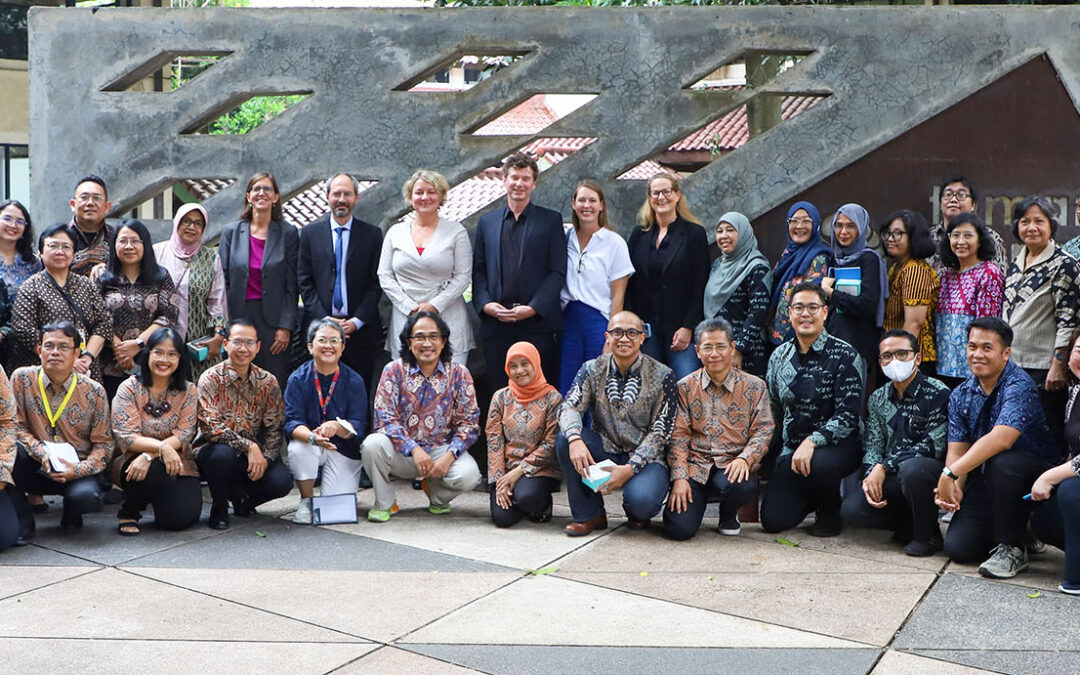
Depok – In an effort to enhance the quality of education globally and ensure that the programs offered meet standards, the Department of International Relations has undergone an international accreditation process that began in early 2023. The culmination of this process was a site visit by Accreditation Agency in Health and Social Sciences (AHPGS), which took place from September 23 to 24, 2024. AHPGS is a highly reputable German accreditation agency that provides comprehensive assessments of various disciplines at the undergraduate and postgraduate levels. Their evaluations cover aspects such as curriculum, teaching quality, infrastructure, and academic support for students.
This visit involved two prominent assessors, Prof. Dr. Sandra Destradi from Albert-Ludwigs-University Freiburg and Prof. Dr. Jakob Lempp from Rhine-Waal University of Applied Sciences, who have extensive experience in evaluating International Relations programs in various countries.

Series of Activities
On the first day, Monday, September 23, 2024, the two assessors were officially welcomed at the University Administration Building by the leadership of FISIP UI, namely Prof. Dr. Semiarto Aji Purwanto, Dean of FISIP UI, accompanied by Nurul Isnaeni, Ph.D., and Dwi Ardhanariswari Sundrijo, Ph.D., Vice Deans of FISIP UI. The visit also involved university leaders who were present to warmly welcome the assessors. After the welcoming session, the assessors proceeded to the Mochtar Riady Building on the 2nd floor to conduct a series of in-depth interviews with teaching staff at the undergraduate and postgraduate levels from the Department of International Relations. The participating lecturers included Prof. Dr. Fredy B.L. Tobing, Prof. Evi Fitriani, Ph.D., Ali Abdullah Wibisono, Ph.D., Ardhitya E. Yeremia Lalisang, Ph.D., Asra Virgianita, Ph.D., Emir Chairullah, Ph.D., Edi Prasetyono, Ph.D., Dr. Ani Widyani Soetjipto, Hariyadi Wirawan, Ph.D., and Gracia Paramitha, Ph.D. The lecturers shared information about the curriculum, research, and their teaching experiences in the Department of International Relations.
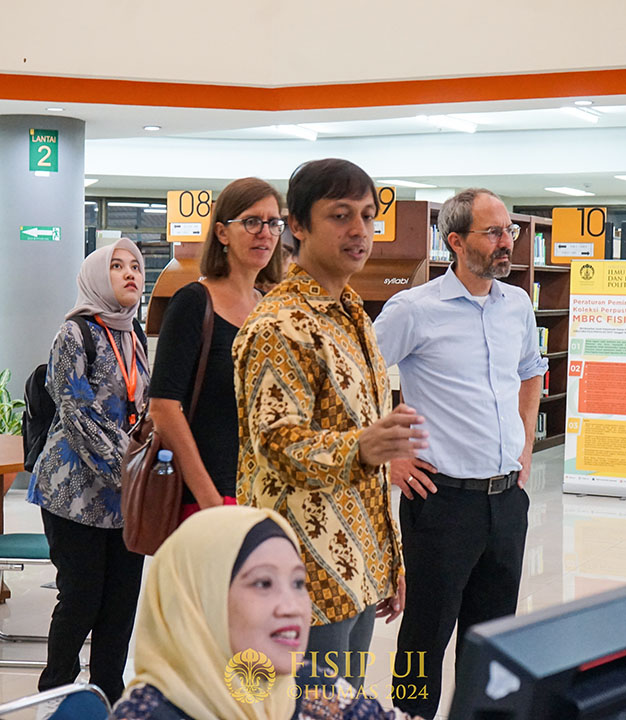
 After the intensive interview sessions, the assessors were invited to take a campus tour around the UI Depok campus. The tour started from the FISIP area, followed by visits to the Central Unit of the Department of International Relations (UPDHI) and the UI International Office. This tour provided the assessors with the opportunity to see firsthand the academic facilities, laboratories, and various other support services available to students on the UI campus. This accreditation visit is an important part of the Department of International Relations’ efforts to continuously innovate and ensure that the academic standards applied are competitive at the international level.
After the intensive interview sessions, the assessors were invited to take a campus tour around the UI Depok campus. The tour started from the FISIP area, followed by visits to the Central Unit of the Department of International Relations (UPDHI) and the UI International Office. This tour provided the assessors with the opportunity to see firsthand the academic facilities, laboratories, and various other support services available to students on the UI campus. This accreditation visit is an important part of the Department of International Relations’ efforts to continuously innovate and ensure that the academic standards applied are competitive at the international level.
Sep 13, 2024 | event
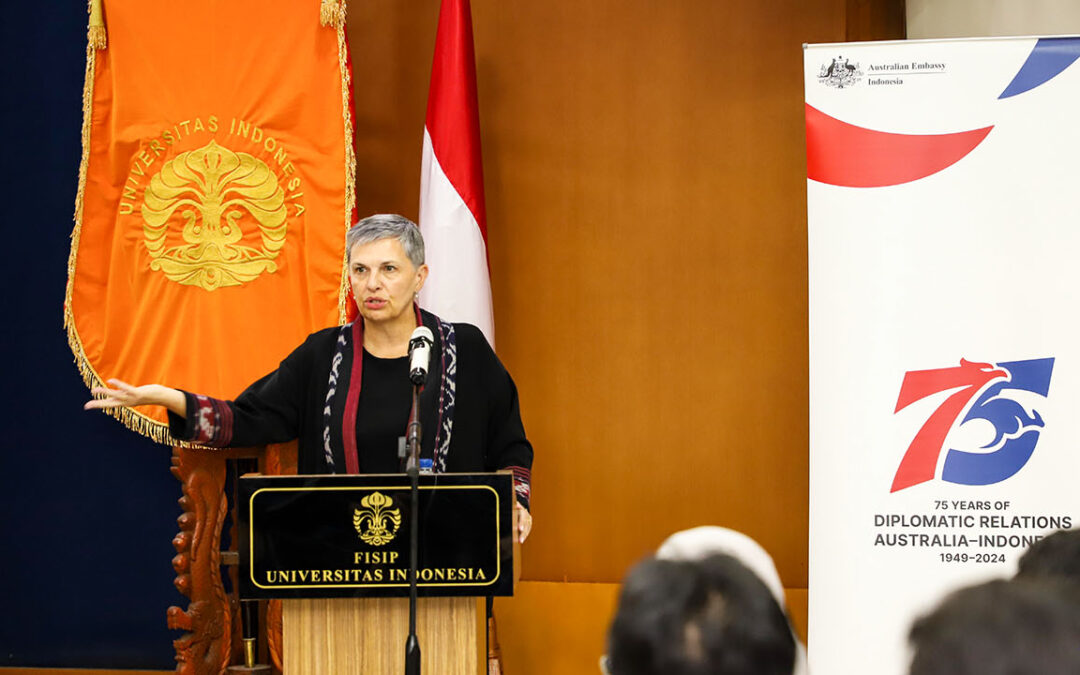
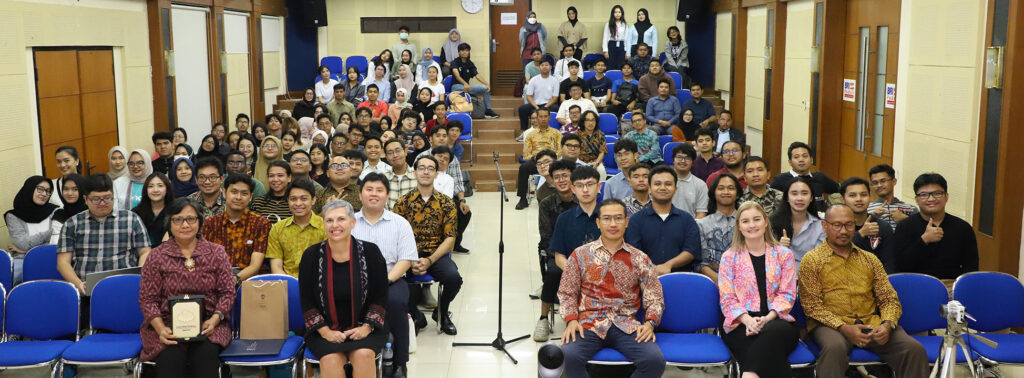
Depok, September 13, 2024 – The Department of International Relations at the Faculty of Social and Political Sciences, University of Indonesia, proudly hosted a studium generale titled “Modern Australia and Its Role in the World,” featuring the Australian Ambassador to Indonesia, H.E. Penny Williams PSM. This public lecture was held on Friday, September 13, 2024, at the Communication Science Auditorium, FISIP UI, and was attended by a large number of students from the International Relations Study Program. The event aimed to provide a deeper understanding of Australia’s role in the international arena, particularly in terms of its diplomacy and foreign policy that influence the global order and bilateral relations with other countries, including Indonesia.
The public lecture was opened by Professor Evi Fitriani, Ph.D., a Professor of International Relations, who stated that Indonesia and Australia have a good relationship. Therefore, this public lecture is expected to broaden insights into Australia and its foreign policy, leading to more collaborations in the future. Following this, Dr. phil. Yandry Kurniawan, the Head of the Undergraduate Program in International Relations, also delivered a welcome speech. In his remarks, he expressed hope that the visit of the Australian Ambassador to Indonesia, H.E. Penny Williams PSM, could be the first step in strengthening relations with the Department of International Relations, as many students focus on Australia in their final projects.

The event continued with an opening by Ristian Atriandi Supriyanto, M.Sc., a lecturer in the Department of International Relations who acted as the moderator. He facilitated the public lecture by guiding an interactive discussion between the Ambassador and the participants. During her presentation, H.E. Penny Williams PSM highlighted various important aspects of Australia, from the cultural diversity that characterizes the country to Australia’s foreign policy based on its values, interests, and national identity. H.E. Penny Williams PSM emphasized that Australia prioritizes not only regional cooperation but also inter-regional relations, including with Indonesia. Additionally, in the context of evolving international relations, Australia, as part of the Pacific region, faces several global challenges such as climate change, maritime security, and other issues that require special attention.
After the presentation by Ambassador H.E. Penny Williams PSM, the public lecture continued with a Q&A session with the students. The public lecture concluded with the presentation of a souvenir from the Department of International Relations to Ambassador H.E. Penny Williams PSM as a token of appreciation for her presence. This event is expected to strengthen the relationship between Australia and Indonesia and contribute positively to the development of knowledge in the field of international relations.


 After the intensive interview sessions, the assessors were invited to take a campus tour around the UI Depok campus. The tour started from the FISIP area, followed by visits to the Central Unit of the Department of International Relations (UPDHI) and the UI International Office. This tour provided the assessors with the opportunity to see firsthand the academic facilities, laboratories, and various other support services available to students on the UI campus. This accreditation visit is an important part of the Department of International Relations’ efforts to continuously innovate and ensure that the academic standards applied are competitive at the international level.