Seminar Mencari Titik Tengah Demokrasi: Antara Keamanan Nasional dan Kebebasan Sipil

Seminar: Searching for the Midpoint of Democracy: Between National Security and Civil Liberties

Depok, 30 May 2024 – The Department of International Relations, Faculty of Social and Political Sciences, Universitas Indonesia, held a seminar on "Searching for the Midpoint of Democracy: Between National Security and Civil Liberties" on 30 May 2024. This event took place from 13.30 to 16.00 WIB at the Auditorium Ilmu Komunikasi and presented several speakers to discuss how to find a balance between the needs of the authorities to maintain national security and ensure that the rights to free-speeches are still fulfilled regarding the issue of the use of spyware in Indonesia.

Broto Wardoyo, Ph.D., lecturer in the Department of International Relations, as moderator, opened the discussion by providing a brief overview of how the issue of spyware in the context of national security and civil liberties is becoming increasingly relevant in society. From a regulatory perspective, Dr. Sulistyo, Deputy for Cyber and Crypto Security for Government and Human Development at BSSN RI, explained the importance of data protection as a national issue.

Brig. Pol. I Made Astawa, Deputy Head of Densus 88 AT Polri, explained that wiretapping carried out by Densus 88 is an important instrument in countering terrorism and emphasized that the main principle in implementing wiretapping is respecting the civil rights while maintaining national security. From a journalist's perspective, Herik Kurniawan, Editor-in-Chief of GTV and Chair of the Indonesian Television Journalists Association (IJTI), explained the role of the media as the fourth pillar of democracy with the challenge of facing regulations that limit the movement of journalists. Mabda Haerunnisa Fajrilla Sidiq, researcher at The Habibie Center, discussed the visibility of the use of cyber as a surveillance tool from a cyber security perspective.

Dr. A. J. Simon Runturambi, Chair of the SKSG UI National Resilience Study Program, underlined the importance of intelligence reform to accommodate civil liberties without disrupting institutions' authority to maintain national security. Ali Abdullah Wibisono, Ph.D., International Security lecturer at the HI Department of FISIP UI, closed the session by discussing in depth the cyber security landscape in Indonesia, which is influenced by the condition of unfinished nation-building and the importance of answering the fundamental question: "Security for whom?" and “Security for what?” –
Download Record Note

Graduate Study Program in the United States: Admission Process and Scholarship Opportunities

Graduate Study Program in the United States: Admission Process and Scholarship Opportunities

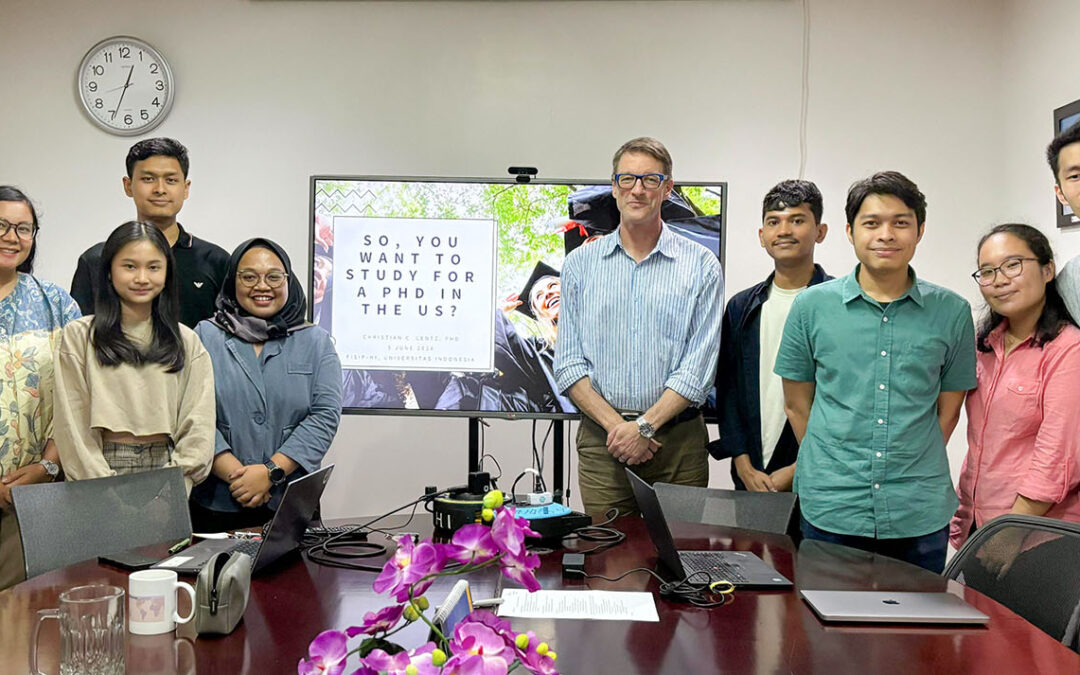
Depok, June 5, 2024 – The Department of International Relations at Universitas Indonesia recently hosted a mini workshop aimed at guiding students through the process of pursuing graduate studies, particularly PhD programs, in the United States. The workshop was presented by Dr. Christian C. Lentz, a distinguished academic with extensive experience in American higher education both as a former graduate student and a current member of an admissions team.

Dr. Lentz’s workshop was designed to provide aspiring PhD candidates with valuable insights and practical advice, drawing from his firsthand experiences. The session began by addressing the fundamental question: Why pursue a PhD in the US? Participants explored the numerous advantages, such as high-quality education, enhanced career opportunities, the chance for in-depth study, and the ability to conduct original research. The discussion also covered potential challenges, including the long duration of study (5-7 years), the demands of English-language instruction, and the highly competitive nature of these programs.

A significant portion of the workshop focused on the initial steps necessary to embark on this journey. Dr. Lentz emphasized the importance of identifying academic interests and long-term goals, selecting the appropriate research methodology (quantitative, qualitative, or mixed-methods), and choosing the right discipline and theoretical framework. He highlighted the critical role of mentorship and provided detailed information on available resources, such as scholarships, Teaching Assistantships (TAships), and grants that support international students.

Choosing the right PhD program is a crucial step, and Dr. Lentz guided participants through the decision-making process. Students learned how to evaluate universities and departments based on their prestige, available resources, and specific program offerings. The session covered strategies for identifying potential professors who could serve on their advisory committee, as well as assessing the level of peer support and competition within each program. Dr. Lentz stressed the importance of making a strong initial contact with potential supervisors, advising students to express their interest and credentials succinctly in their first email, followed by inquiries about the professors’ availability for PhD supervision.

The workshop concluded with comprehensive guidance on the application process. Participants received tips on crafting a compelling Statement of Purpose (SOP), approaching letter writers for recommendations, and preparing a strong CV with writing samples. A detailed application timeline was provided, outlining key steps from initial outreach in August to beginning the visa process in April. The interactive sessions included practical exercises to help students identify suitable programs, draft introductory emails, and outline their SOPs.

Additionally, securing your own funding for a PhD, such as through the LPDP scholarship from the Indonesian government, can significantly enhance your chances of being accepted into US universities, as it reduces their financial burden. However, most PhD programs in the US offer financial assistance through departmental funding, although the specifics can vary from one state to another. Therefore, it is crucial to focus on understanding the application process and building connections with potential advisors to increase your chances of success in pursuing graduate studies in the US.

Accessibility