AI, Geopolitics, and Cyber Threats: Challenges to Indonesia’s Digital Sovereignty in the Era of Global Technology Competition
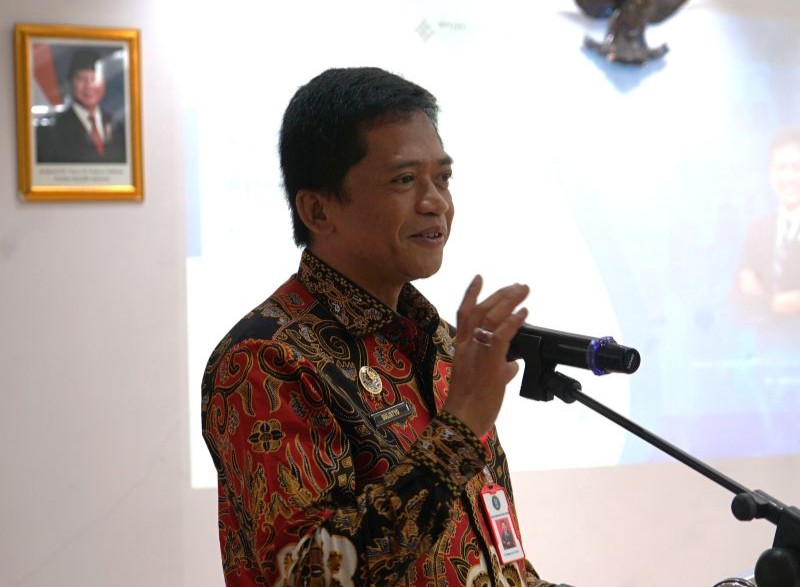
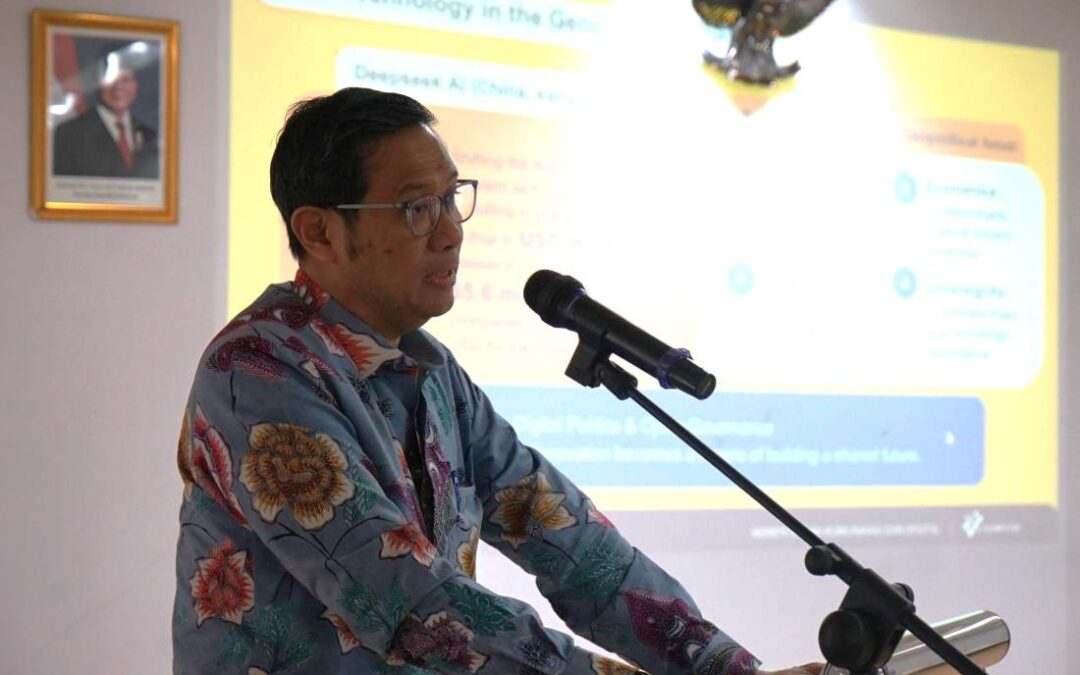
At the International Postgraduate Student Conference (IPGSC) organized by the Graduate Program in International Relations, Universitas Indonesia, on October 23-24, 2025, Raden Wijaya Kusumawardhana—Expert Staff to the Minister of Communication and Digital Affairs for Social, Economic, and Cultural Affairs—representing the Minister of Communication and Digital Affairs, delivered a keynote address on the dynamics of artificial intelligence (AI), geopolitics, and cyber threats in the digital era.
Raden Wijaya emphasized that the world is now entering a phase where data and algorithms have become strategic commodities, and digital technology functions as the infrastructure of global power. AI not only impacts economic and social innovation but also plays a role in shaping and competing for global power.
AI and the Shift in Global Technology Power
In his address, Raden Wijaya highlighted how the emergence of DeepSeek from China has disrupted the dominance of Western AI companies. With an investment of only 6.5 million USD, this technology caused the global AI market valuation to drop from approximately 1 billion USD to 969 million USD, demonstrating how rapidly and competitively the global technology ecosystem is evolving.
He also underscored that conflicts such as Iran-Israel and the Russia-Ukraine war have shown a surge in AI use in defense operations, intelligence analysis, and autonomous weaponry. Factors such as AI’s dual-use nature, its connection to the microchip industry, the ability of states possessing superior AI to shape international standards, and the risks of technological dependency have become key reasons why AI is now a highly determinative geopolitical issue.
Emphasis on Cyber Threats: Threat Characteristics and Dual-Use Nuances
Raden Wijaya emphasized that cyber threats in the digital era possess increasingly complex characteristics, are borderless, and have a dual-use nature. Technology initially developed for civilian purposes can now be repurposed for offensive operations by both state and non-state actors.
First, cyber threats are dual-use in nature. Digital infrastructure, software, AI algorithms, and cloud computing technology designed to enhance civilian sector efficiency can easily be exploited for network penetration, sabotage, or intelligence operations. States utilize these capabilities in strategic competition, while non-state actors such as cybercriminals, hacktivist groups, and armed organizations can leverage them for data manipulation, hacking, or attacks on public services.
Second, the character of cyber threats is asymmetric. States with high capabilities can launch precision attacks on other countries’ critical infrastructure. However, at the same time, small groups with limited resources can even cause significant damage through malware, botnets, or zero-day vulnerability exploitation. This makes cyberspace an open operational field for both large and small actors.
Third, cyber threats are characterized by ambiguity and attribution difficulties. Attacks are often conducted through proxies—whether criminal groups, technology consultants, or independent actors—making it difficult to definitively identify the attacking state. AI technology exacerbates this complexity by accelerating attack automation, producing manipulative content at scale, and helping to discover system vulnerabilities with high precision.
Fourth, cyber threats are very often linked to information operations. Generative AI can produce disinformation and digital propaganda used by both states and non-state actors to influence public opinion, disrupt domestic stability, or delegitimize public institutions.
Through these points, he emphasized that cyber threats are not merely technical issues but strategic threats that challenge digital sovereignty, national security, and political stability. Indonesia must strengthen national cyber resilience, build deterrence mechanisms, and develop a digital talent ecosystem to ensure control over technology that is increasingly integrated into daily life.
Indonesia and Digital Sovereignty in the Era of AI Competition
Raden Wijaya affirmed that Indonesia needs to develop a digital strategy focused not only on innovation but also on security. Investment in digital talent development, AI research, microprocessor infrastructure, and protection of critical infrastructure forms the foundation for Indonesia’s digital sovereignty amid global competition.
In closing his keynote address at IPGSC, he emphasized that the future will not only be determined by who possesses the most advanced technology, but by who is capable of securing, managing, and defending that technology as part of national interests.