
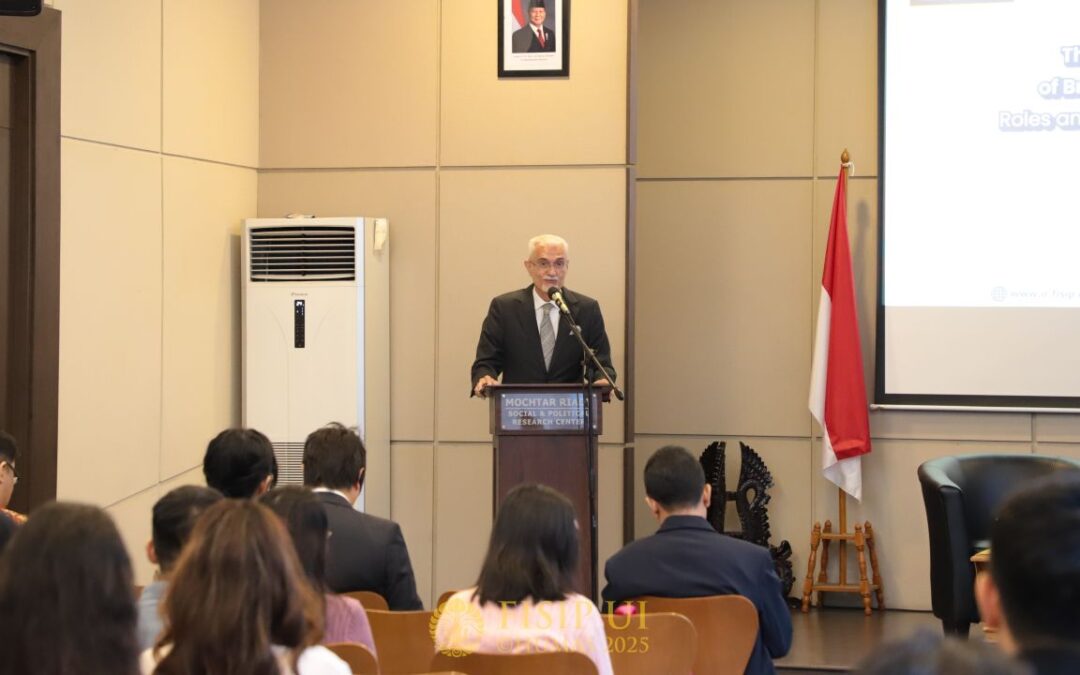
As global power dynamics continue to shift and the Global South rises in influence, the Department of International Relations (DHI) at FISIP Universitas Indonesia took centre stage in this conversation by hosting a dynamic Studium Generale on May 20, 2025. The event, titled “The Leadership of Brazil in BRICS: Roles and Challenges,” featured none other than H.E. George Monteiro Prata, Ambassador of the Federative Republic of Brazil to Indonesia. In a room filled with students, scholars, and policy enthusiasts, the Ambassador delivered firsthand insights on Brazil’s strategic vision within BRICS and its efforts to champion dialogue, multilateralism, and inclusive global governance.
In his address, H.E. Ambassador Prata emphasized Brazil’s central role as a founding member of BRICS (Brazil, Russia, India, China, and South Africa) and clarified that BRICS is not an anti-Western coalition. Rather, it reflects a shifting global order where economic and political power is becoming increasingly multipolar. “BRICS is not an anti-Western front,” said H.E. Ambassador Prata. “We are here to promote dialogue, not confrontation. What we aim for is building bridges between different regions and perspectives.”
H.E. Ambassador Prata highlighted the three core pillars of BRICS cooperation: policy and security, economic and financial collaboration, and people-to-people exchange. Brazil’s foreign policy, according to him, is rooted in multilateralism and inclusivity, advocating for engagement through global forums such as the G20 and BRICS to advance dialogue-based approaches. In discussing economic cooperation, H.E. Ambassador stated, “We are not trying to replace the US Dollar, but to open new opportunities in international trade,” in reference to BRICS’ exploration of using local currencies like the Rupee and Renminbi.

The question-and-answer session revealed significant interest from the audience, with inquiries on BRICS’ internal coherence, expansion, trade systems, and conflict resolution mechanisms. H.E. Ambassador Prata responded by noting that differences among member states are part of the organization’s daily reality. “We do not build walls to divide us—differences are part of our daily diplomacy. Finding common ground is essential to move forward as a collective,” he explained. H.E. Ambassador Prata also addressed the challenges ahead for BRICS, noting that the greatest task lies not in expanding the organization’s membership but in making its cooperation more meaningful.
Through this event, the Department of International Relations FISIP UI reaffirmed its role as a hub for critical reflection and scholarly engagement on pressing issues in international political economy and emerging global institutions.