
Vol. VII / No. 13 | September 2026
Authors:
Keziah Friskila Roostee – An undergraduate student of international relations at Universitas Indonesia with an interest in IPE and business, and sustainable development.
Summary
Reflecting on the 1998 Asian financial crisis and the 2008 global financial crisis, large-scale financial disruptions are characterized by massive capital flight, which devalues currencies and equities, and precipitates recession. This commentary argues that crisis-like symptoms emerged in Indonesia during the first half of 2026, exacerbating existing vulnerabilities in the national economy. Despite several government efforts, vulnerabilities persist. To prevent future financial crises, the government must strategically manage the weakening economy and rebuild public trust.
Keywords: financial crisis, currency stability, capital flight
External Shock and Internal Vulnerabilities Leading to Economic Downturn in the First Half of 2026
The escalation of Middle East conflicts has exposed Indonesia’s economic vulnerability to the global energy crisis. The Strait of Hormuz, a chokepoint carrying 20% of global oil consumption and 84% of Asia’s crude supply, saw disrupted trade that drove Brent crude prices up 13% by late February 2026. As a net oil importer, Indonesia felt this directly. In April 2026, two Pertamina tankers carrying two million barrels of crude oil were stranded in the strait. Despite the Foreign Minister’s claims of a secure national supply, anxiety manifested in restricted subsidized fuel purchases, energy conservation campaigns, and mandatory Work From Home for civil servants every Friday starting March 2026.
Beyond energy, supply chain disruptions in the Strait of Hormuz rippled through the domestic economy. Consumer goods and raw material price increases burdened households and industries. Essential material prices like plastic spiked 80%, squeezing businesses. This inflation worsened as the rupiah hit a historic low of surpassing its June 1998 crisis-era level of 16.650.
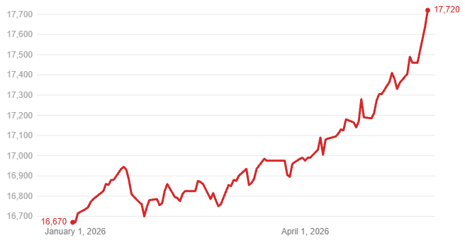
Movements in the Rupiah Exchange Rate, January–May 2026
Source: CNBC
Consequently, the real sector slowed, with declining Consumer Confidence Index and Manufacturing PMI from February to April 2026 signaling reduced household spending and contracted manufacturing activity.
However, this external shock is not a single provoking factor. It exposed two conditions of Indonesia’s existing systemic vulnerabilities. First, living costs are rising faster than incomes, echoing the 2008 crisis, where U.S. household debt outpaced income growth (Mian and Sufi, 2014: 76-9). The depreciating rupiah’s impact on living costs is expected to be felt more intensely in the second half of 2026. Although the government has yet to raise the price of subsidized fuel, non-subsidized fuel hikes have inflated logistics costs, while reliance on imported wheat, soybeans, and sugar is pushing up food prices, squeezing Indonesia’s already wage-stagnant middle class and making it harder for households to build lasting asset value.
Second, fiscal space is narrowing under heavy government spending. The Free Nutritious Meals (MBG) program alone is projected to cost Rp320 trillion this year, about 10% of the 2026 revenue budget, drawing skepticism from The Economist over its execution. Compounding this, even assuming global oil prices reach USD100 per barrel, the government has committed to maintain fuel subsidies while maintaining a 2.92% budget deficit. Besides the danger of reaching the legal 3% ceiling, economists have been warning that fiscal capacity can only bear this commitment in the short term.
By the end of March 2026, government spending surged 31.4% against 10.5% revenue growth. If global economic turmoil does not subside, the cost of maintaining fuel subsidies will become increasingly expensive, forcing the government to take on more debt within a limited fiscal space. Historically, unregulated debt surges preceded both the 1998 and 2008 crises (Oatley, 2012: 328-30), underscoring the need to preserve fiscal space as a safety net.
The Burning Wick: Eroding Institutional Trust Provoking Financial Crises
Beyond global shocks and domestic vulnerabilities, growing concern over the checks and balances among the executive, legislature, and central bank has further unsettled investors. The February 2026 appointment of Thomas Djiwandono—the President’s nephew—to Bank Indonesia’s Board of Governance was widely viewed as a threat to institutional independence. Following that appointment and the continuously weakening rupiah, the revised P2SK law expanded Bank Indonesia’s mandate to support economic growth. According to Mukhamad Misbakhun—Chair of the House of Representatives Commission XI—this is necessary to achieve President Prabowo’s 8% growth target. In July 2026, public concerns about the weakening institution were reinforced as the Bank Indonesia’s governor, Perry Warjiyo, resigned before his term ended, an announcement that alone knocked the Composite Stock Price Index (IHSG) down by 0.17% and weakened the Rupiah to Rp18,009/USD.
The fallout has been visible in markets. The IHSG has declined and 18 companies were dropped from the Morgan Stanley Capital International (MSCI) index, triggering capital flight from stocks and government bonds between April and May 2026, a contrast to rising equity indices in regional peers like Japan, China, and Singapore. International outlets including Bloomberg and the Strait Times have documented a “sell Indonesia” trend among global investors. Domestically, panic shows up in currency hoarding: in June 2026, Bank Indonesia reported that rupiah-denominated deposits grew 6.3 percent year-over-year, while foreign-currency deposits surged nearly three times faster, at 18.5 percent.
However, while capital flight has been happening, in fact, Indonesia’s current macroeconomic indicators are relatively stable compared to the 1998 financial crisis, except for a record low of the Rupiah.
| Indicators | 1998 | 2026 |
| Rupiah’s Exchange Rate Against the U.S. Dollar | Rp 17.000~ | Rp 18.000~ |
| Inflation (year-on-year) | 77,6% | 2,42% – 4,76% |
| GDP Growth (year-on-year) | -13,7% | +5,61% |
| Foreign Debt-to-GDP Ratio | 148% | 29,5% |
Source: Central Statistics Agency (BPS) and Bank Indonesia
However, complacency would be a mistake. The rupiah ranks among the world’s ten weakest currencies, and continuous weakening would trigger a larger domino effect on the economy, such as declining purchasing power and costlier imports of essentials like fuel and fertilizer. The government has to be careful, especially as the US-Iran stalemate leaves the Hormuz Strait’s reopening uncertain. Should investor confidence erode further, the result could be speculative attacks, the same dynamic that catalyzed the 1998 crisis (Stiglitz, 2022:94).
Responding to Crisis Tendencies and Preventing a Worse Future Scenario
In response to the current turmoil, the government has not been passive. On the fiscal side, it has trimmed budgets, sustained subsidies for the real sector, and cut the free-meal program’s allocation. On the monetary side, Bank Indonesia raised its benchmark interest rate (BI Rate) to 5.25% and deployed over USD10 billion in foreign exchange reserves to defend the rupiah.
Officials have also tried to talk up confidence, such as the Finance Minister’s projection of a stronger Rupiah and the National Economic Council (DEN) chairman, Luhut Binsar Pandjaitan, assured global investors that Indonesia’s economy remains relatively strong, pointing to 5.61% first-quarter growth. Yet rhetoric alone has proven less persuasive to markets than concrete evidence of institutional credibility. What has moved markets is action: on August 10, 2026, President Prabowo nominated Destry Damayanti, BI’s acting governor and a career central banker, as the sole candidate for the permanent governorship, rather than a more politically-aligned figure. The rupiah strengthened roughly 0.75 percent on the news, reversing months of anxiety over the central bank’s independence.
To avert a future crisis, four priorities remain. First, stabilizing the rupiah is vital to protect domestic purchasing power and anchor global investor confidence. The President and DPR RI should carefully appoint credible people to fill the central bank’s governor role. Though the nomination of Destry still awaits parliamentary confirmation, the market reaction lends credence to a credible, independence-preserving leadership at Bank Indonesia for restoring investor trust.
Second, Indonesia should pursue energy independence. Despite ranking second in energy resilience from natural gas and coal by a JPMorgan report, Indonesia’s massive transport sector remains dangerously dependent on crude oil, and the rolling blackouts from PLN in Java underscore the need for more strategic governance beyond commodity optimization. As a net oil importer facing production decline and consumption rise, energy diversification is a long-term strategy for energy security. The current B50 initiative may be one of the building blocks, and it should be supported for quality and access improvement.
The last and most important point is trust. As markets’ positive reaction to Destry Damayanti’s nomination suggests, maintaining market confidence requires preservation of Bank Indonesia’s independence. Additionally, ensuring that numerical growth is translated into the market is also crucial so that it is felt by society. Therefore, trust could grow from where it naturally emerges.
Conclusion
Although Indonesia’s macroeconomic indicators remain relatively stable compared to 1998, a financial crisis remains possible if domestic vulnerabilities are left unaddressed. A weakening rupiah combined with an economic slowdown signals the kind of instability that erodes global investor confidence. To mitigate this risk, the government must prioritize rupiah stability to prevent capital flight, accelerate energy self-reliance as a long-term hedge against global uncertainty, and continue rebuilding the public and institutional trust that ultimately underpins financial stability.