

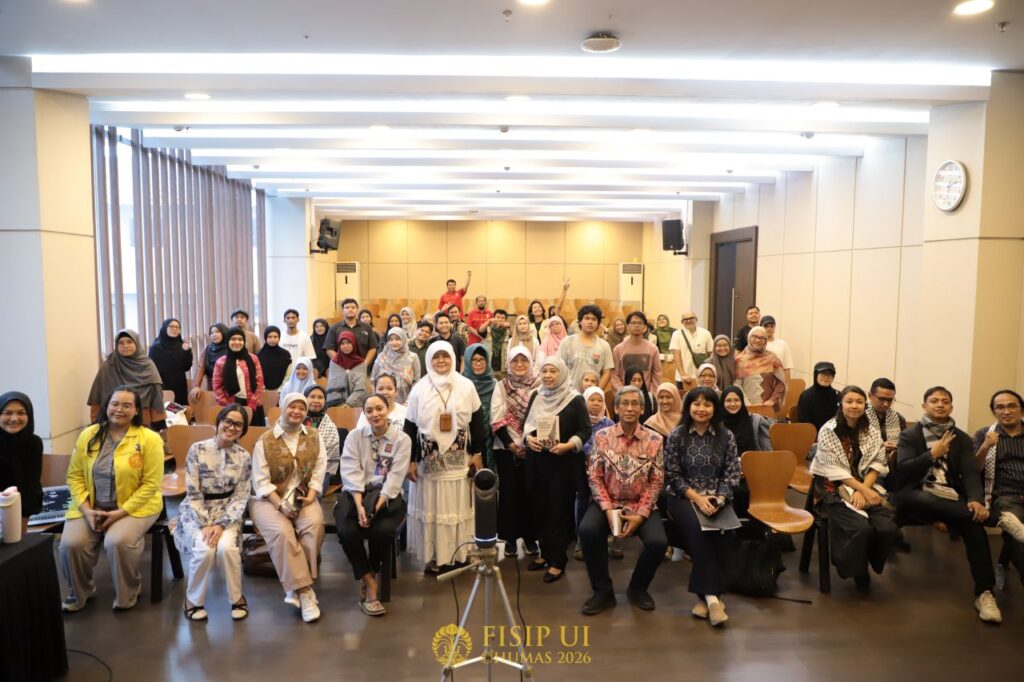
Depok, Indonesia — 19 August 2026 — The Department of International Relations, Faculty of Social and Political Sciences, Universitas Indonesia (IR UI), through the Southern Solidarity, Development and Transformation for Just Governance Cluster, held a book discussion and exhibition titled “Towards Palestinian Liberation: Anti-Colonialism Solidarity from Indonesia for Palestine.”
The event brought together academics, civil society organizations, researchers, artists, students, and members of the public to reflect on Palestine through the lens of anti-colonialism, solidarity, and the long history of struggles for self-determination.
The event was organized in collaboration with the UI Palestine Center, Transnational Institute, KontraS, BDS Indonesia, Republika, Adara, SMART 17, INADIS Horizon, Amnesty International, CHIKIGO, Aqsa Working Group, and SJP UI.
Rather than approaching Palestine solely as an ongoing conflict, the discussion invited participants to examine the issue through a broader historical and structural perspective—one that considers colonialism, power relations, displacement, inequality, and the continuing struggle for liberation. The moderator, Agung Nurwijoyo, M.Sc., emphasized that the discussion sought to move beyond conventional understandings of conflict and ask a fundamental question: Is solidarity enough if it stops at moral sympathy?
Palestine Beyond Conflict
The discussion began with remarks from Asra Virgianita, Ph.D., Head of the Southern Solidarity, Development and Transformation for Just Governance Cluster, who emphasized that solidarity with Palestine is not a new initiative for IR UI. Similar activities have been organized by the Department since 2024, reflecting an ongoing commitment to keeping humanitarian issues within academic conversations.
Asra also stressed the importance of collaboration across different sectors in supporting Palestinian freedom, while emphasizing that the issue should be understood fundamentally as a humanitarian issue rather than a religious one. She highlighted the role of academia in continuously bringing humanitarian questions into public and scholarly discourse and expressed hope that the discussion would deepen participants’ understanding of Palestine and broaden the reach of solidarity efforts.
Reconnecting Palestine with the History of Liberation
The event was officially opened by Prof. Hamdi Muluk, Vice Rector for Research, Innovation, Student Affairs and Alumni of Universitas Indonesia. In his remarks, he emphasized the importance of the forum as a space for learning, critical discussion, and solidarity, while highlighting the role of the newly strengthened UI Palestine Center as a platform for research, education, dialogue, and engagement on Palestine.
He also underlined the relevance of an anti-colonial perspective in understanding Palestine—not simply through recent events, but through the longer history of occupation, unequal power relations, injustice, and struggles for self-determination. The discussion was also connected to Indonesia’s own historical commitment to anti-colonialism and the principle, enshrined in the Preamble of the 1945 Constitution, that independence is the right of every nation.
The book discussion featured Hamza Hamouchene and Abi Bae from the Transnational Institute, Shofwan Al Banna Choiruzzad, Ph.D. from the Department of International Relations FISIP UI, and Nadine Sherani Salsabila from KontraS.
Hamza Hamouchene situated Palestine within a longer history of struggles for self-determination and anti-colonial liberation. He argued that the situation in Gaza must be understood beyond immediate violence, including its wider dimensions of trauma, isolation, oppression, and international solidarity. He also emphasized the significance of Global South solidarity in challenging structures of domination and imagining a more just international order.
Abi Bae focused on the territorial, historical, and political dimensions of the Palestinian question. His discussion highlighted the centrality of land and the right to a homeland, while connecting Palestine to broader regional structures and the political and economic interests underpinning normalization and control over resources.
Meanwhile, Shofwan Al Banna Choiruzzad, Ph.D. connected the Palestinian struggle to Indonesia’s own anti-colonial history. He reflected on the legacy of Soekarno, the Bandung Conference, and Indonesia’s historical role in supporting global decolonization. For him, Indonesia’s independence was not simply a national achievement but was also connected to a broader vision of a world order opposed to colonialism.
Nadine Sherani Salsabila emphasized the importance of viewing Palestine through a long-duration perspective. Rather than reducing Palestine to a crisis beginning in October 2023, she argued for understanding the longer history of displacement, oppression, and colonial structures that continue to shape the present. She also raised an important question about the sustainability of solidarity movements and the need to translate solidarity into concrete action.


Solidarity Through Art
The intellectual discussion was complemented by the “Solidarity through Art” exhibition, demonstrating how solidarity can take forms beyond academic debate.
The exhibition brought together artistic expressions, while solidarity merchandise booths provided another avenue for public participation, with proceeds donated to Palestine. The program also featured musical performances by Bella Fauzi, representing the Tanah Para Nabi Movement.
Through music and art, the event sought to expand the ways in which Palestine can be communicated to broader audiences. Bella Fauzi emphasized that the Palestinian question should be understood as a humanitarian issue and highlighted the importance of diversifying approaches to sustaining public awareness and solidarity.
From Memory to Action
One of the strongest themes emerging from the discussion was that solidarity requires continuity.
The conversation with students and participants raised questions about sustaining Palestine solidarity movements amid competing domestic concerns, encouraging awareness among younger generations, supporting boycotts, and understanding the relationship between critical mineral extraction, geopolitical competition, and the sovereignty of Global South countries.
The discussion also challenged the idea that attention to domestic issues must come at the expense of solidarity with struggles elsewhere. As Nadine emphasized, solidarity should not be organized around a hierarchy of suffering. Rather, solidarity can be understood as borderless, connecting struggles for justice across different contexts.
The event ultimately positioned Palestine not only as an issue of contemporary international politics, but as part of a wider conversation on colonialism, self-determination, human rights, Global South solidarity, and the politics of memory.
For IR UI, the event reflects the role of the university as more than a producer of knowledge. It is also a space where knowledge can be questioned, exchanged, and connected with social engagement through dialogue, research, education, community work, and collaboration.
The “Towards Palestinian Liberation” discussion and exhibition therefore served not simply as a one-day event, but as an effort to keep Palestine present in academic and public conversations—while strengthening the connections between knowledge, collective memory, and anti-colonial solidarity.