

Vol. VII / No. 9 | May 2026
Authors:
Ahmad Fauzan Abbas – International Relations Graduate from Hasanuddin University
Summary
Populism in Japan is rooted in unresolved socioeconomic problems and dissatisfaction with the government. We then expand our discussion to assess the possible implications of populist aspirations towards Japan’s Official Development Assistance (ODA) programme in ASEAN. We found that the surge of populist campaigns in Japan has not gathered sufficient power to influence the flow of Japan’s ODA. This essay serves as a preliminary research on the growing literature that seeks to explain the rise of populism in Japan and its implications for Japan’s foreign policies.
Keywords: Populism, Official Development Assistance, Japan-ASEAN Relations
Populism In Japan
Japan’s Liberal Democratic Party’s (LDP) poor performance in the 2024 and 2025 elections has brought two implications. First, as the ruling party, the LDP’s consecutive losses in the 2024 and 2025 elections have weakened the party’s stance in the parliament (Govella, 2025). Grappling with this dilemma, Shigeru Ishiba, LDP’s sitting president and the prime minister of Japan, was forced to resign. After a tight LDP presidential election in the runoff, Sanae Takaichi soon assumed the party’s executive and the prime minister’s office. Second, the election campaign showed a rising concern regarding populist aspirations, which strongly correlates with the election result. The emergence of populist trends in Japan’s politics may be rooted in public dissatisfaction with socioeconomic problems. Key issues include the weakened Japanese economy and loose immigration policies (Kimijima, 2025 ; Higuchi & Koo, 2025).
History has shown examples where populist regimes redirect their country’s foreign policy towards more hostile relations with others. Donald Trump is a notable example, with political scientists referring to him as a populist par excellence (Oliver & Rahn, 2016). Trump also shares the same narrative that immigrants enjoy the social benefits while the “true” citizens must endure economic hardship. His populism also pushes for re-orientation towards domestic issues. ASEAN countries then started to contemplate the impact of the populist wave in Japan that might influence how the Japanese view Official Development Assistance (ODA) in the region.
How Populism Influenced Foreign Aid?
There is still substantial debate among academics regarding the solid definition of populism (Mudde & Kaltwasser, 2017 ; Laclau, 2005). However, one shared element among them is the narrative of the “people majority” vs “elite minority”. This element is also highlighted in one of the most widely used approaches in the study of populism, the “ideational approach”. In this perspective, populism is seen as a thin-centered ideology. The society then separated into two clusters: “the pure people” against “the corrupt elite”. This approach believes that politics should express the general will of the people (Mudde, 2004).
Political scientists keep working to expand the study of populism, including on how populist movements may impact a country’s foreign policies. Destradi’s elaborate work (2025) on populism and foreign policy theorisation examined the correlation between the two through Mudde’s ideational approach. According to Destradi, as the consequences of populism as a “thin-centered” ideology, the effects do not directly translate as the substance of a country’s foreign policies. Rather, populist regimes influence foreign policies in procedural practices, that is, through personalization and mobilization.
Investigating the correlation between populist sentiment and foreign aid remains a relatively niche theme in the study of IR. Heinrich et al. (2021), offer a systemic examination of the relationship between the two. They conclude that anti-elitism and nativism (a major theme of populist campaigns) correlate with the reduction in government spending on foreign aid. The argument is that, in democratic competition, the incumbent government seeks electoral support from the masses. The electoral motives then allow the public to dictate government foreign aid spending.
Sanseito’s Populism and The Prospect of Japan’s ODA
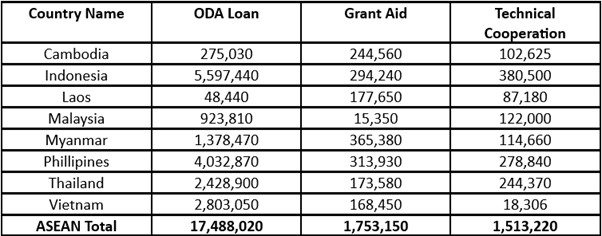
The presence of populist campaigns could direct Japan’s foreign policies into an inward-looking stance. Questions have arisen about whether this may adversely affect foreign aid to recipient countries, notably, the members of ASEAN. A review of the figures (Table 1) indicates that a huge proportion of Japan’s ODA is distributed among Southeast Asian countries.
Japan’s ODA to ASEAN (in million yen)
Source: ODA Data Book by Country 2023, MOFA, in
the Ministry of Foreign Affairs of Japan (MOFA), 2025.
These concerns are not without basis. Shortly after being re-elected, President Trump instructed the suspension of U.S. foreign aid to other countries. The White House (2025) argued that the halt was intended to reassess the programme, which is distributed through various schemes of humanitarian issues. The policy itself is in line with Trump’s America First campaign. A populist proposal proved successful in securing his victory in the 2024 presidential election.
Sanseito, a rising populist opposition party in Japan, has consistently aligned with populist rhetoric that mobilizes the masses who are insecure about the current socioeconomic reality of today’s Japan (Takao, 2025). This faction later antagonizes the elite, whom they believe are responsible for the problems faced by Japanese society. In this context, Sanseito’s Japanese First slogan is a direct rendering of Trump’s America First. Both campaigns share the same characteristics. They embrace the ultra-conservative and nationalist ideologies while blaming the immigrants, liberal elites, and foreign capital (McCurry, 2025). The question that arises is whether Sanseito would also target Japan’s ODA scheme?
The short answer is no. As of today, Sanseito has never directly expressed any objection towards Japan’s ODA programme. Nevertheless, they repeatedly express their pessimistic stance towards globalism, which they view as a large corporation and the ideology of capital owners. From their view, globalism only produces economic injustice, undermines democracy, weakens the middle class, and erodes national sovereignty and identity (Sugawara, 2025).
If Sanseito decides to oppose the ODA programme, they would not be able to push for any substantial change of said policy, given the small size of their coalition inside the government. Here lies the major difference between Trump’s America First and Sanseito’s Japanese First: one represents a ruling regime, while the other is a minority opposition. Nevertheless, Sanseito’s popularity has increased in the last three elections. The party managed to increase the size of its seat in the House of Representatives to fifteen in the latest general election (Sonobe et. al., 2026). If this tendency continues, then Sanseito can be a game changer in Japanese foreign policy-making.
Putting Takaichi in the Equation
Our focus now turns to Sanae Takaichi. As the Prime Minister of Japan, her stance on Japanese ODA is significant. On various occasions, Takaichi has campaigned in line with Sanseito’s sentiments (see Simpson, 2025). Despite her use of populist rhetoric, Takaichi cannot be simply labelled as a populist actor. We need to differentiate between a populist and an opportunist who use general populist themes (such as conservatism and nationalism) to secure their vote.
As Prime Minister Shinzo Abe’s protégé, Takaichi is likely to continue the legacy of her mentor, the existing Free and Open Indo-Pacific strategy (Anindya, 2025). Takaichi will not deliberately sever ties with ASEAN, given its centrality to Japan’s economy and regional stability. Developing countries that act as an economic engine for ASEAN, such as Indonesia, Vietnam, and the Philippines, are expected to continue receiving assistance for domestic infrastructure and institutional initiatives.
Through the ODA programme, Japan has actively contributed to the development of ASEAN member states. In Jakarta and Manila, Japan has supported public transportation projects. In disaster risk management, the Japan-ASEAN Integration Fund has supported ASEAN’s humanitarian assistance and disaster management efforts. In terms of health cooperation, Japan has assisted ASEAN in strengthening the association’s capacity to respond to public health emergencies (MOFA, 2025).
In our analysis, Takaichi would respond to the citizens of Japan’s opinion on the issue of international cooperation funding. A poll from the Ministry of Foreign Affairs (2026) showed that 50,3% of Japanese respondents believe that the ODA scheme plays a role in securing resources and food. Some respondents also agree that ODA helped to promote peace, stability, and increase the prosperity of Japan while also increasing Japan’s exports. This highlights the positive sentiment of Japan’s citizens towards the ODA strategy.
To conclude, the generally positive sentiment among citizens validates the government’s policy on ODA spending. The populist actor Sanseito has also not targeted international assistance policy on a large scale, in contrast to the Trump administration in the United States. Populist in Japan have instead focused primarily on domestic socioeconomic issues, such as immigration and the economy. This helps explain the near absence of campaigns against ODA in Japan, which in turn supports the continuation of the program.